
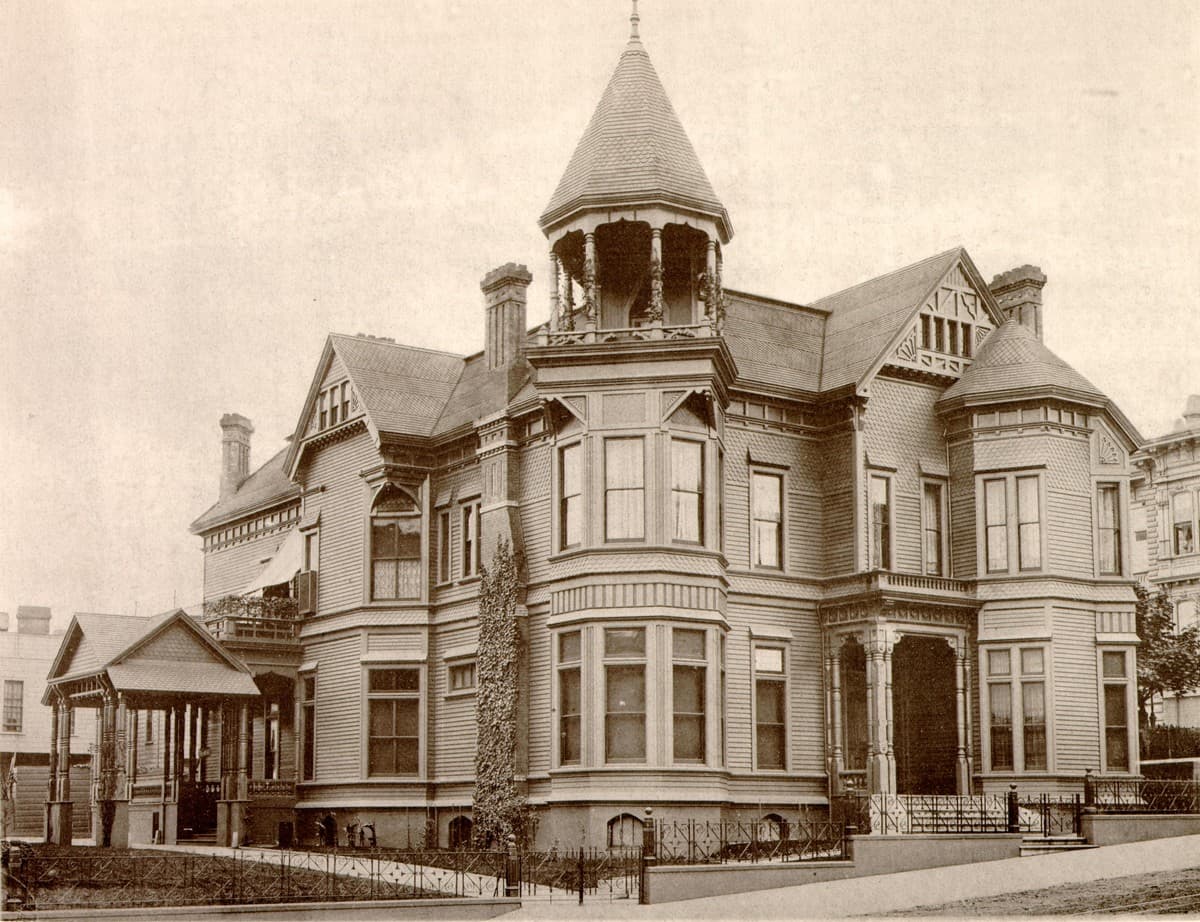
Arnold Genthe, Sacramento Street, April 18, 1906 · Library of Congress
San Francisco burned. This mansion didn't.
In 1881 a silver heiress built a mansion on Sutter Street and put it in her own name. Twenty-five years later the city fell down and burned, the Army dynamited this block to stop the flames, and when the smoke cleared it was still standing. It has been standing ever since: through a YMCA, an antiques dealer, a room full of doctors and one very strange year on Airbnb. This is how it got from there to your room upstairs.
- The year it went up
- 1881
- The year it stayed up
- 1906
- On the National Register
- 1980
- Rooms in the mansion
- 12
Begin in 1881, on a stretch of Sutter Street you would not recognize today: a run of new mansions going up one after another, each one built to be looked at. Almost none of them are still standing. This one is. What follows is the story of how that happened: the silver that paid for it, the architect who could not resist showing off, the morning the city came down, and the hundred years afterward in which this mansion was a meeting hall, a shop, an office, a wedding venue and, briefly and absurdly, the most expensive place to sleep in San Francisco. It is a long story with a short ending: the mansion is still here, there is a room in it, and you are very welcome.
- Chapter I1878-1881
It Started With Silver
William S. O'Brien was one of the four men San Francisco called the Bonanza Kings, the ones who gambled on the Comstock Lode in Nevada and won so extravagantly that the city struggled to describe how rich they had become. O'Brien never married. When he died on May 2, 1878, his fortune came apart across a scatter of relatives, and one of them did remarkably well out of it: a niece named Mary Pauline O'Brien, who received roughly $300,000, more than twice the share of anyone else named in the will. She was, the record is clear, his favorite.
What she did with it is the reason you are reading this. Two years later, on July 21, 1880, she married Theodore Fryatt Payne, a manufacturer of bolts, the son of a Gold Rush fortune, an entirely sensible match. And the story San Francisco told itself, at every dinner table that mattered, was that old William had tied the money up so carefully that it would stay hers no matter whom she married. Whether that is true is lost. The deed is not. When ground broke on Sutter Street in the last months of 1881, it broke in her name.
- May 2, 1878William S. O'Brien dies unmarried; his Comstock fortune passes to his favorite niece, Mary Pauline: roughly $300,000, more than twice any other heir's share.
- July 21, 1880Mary Pauline O'Brien marries Theodore Fryatt Payne, owner of a San Francisco bolt works.
- Late 1881Construction breaks ground, in her name.
- Chapter II1881-1882
Built to Outclass the Block
She chose her architect well. The brief William Curlett was given is still legible in the building itself: make it look as though it has always been here, and make certain the neighbors notice. He worked in the fashionable manner of the moment (Eastlake and Stick, with the new Queen Anne coming in at the edges), and what he produced is the mansion you can walk past today. An octagonal turret, open at the top, of the shape the Victorians called a candle-snuffer. Bay windows arranged with a deliberate refusal to line up. A roof that climbs. And a porte-cochère at the side, so that anyone arriving in weather never had to stand in it. That last one is gone (a street-widening took it decades later), and it is very nearly the only thing about this mansion that has changed.
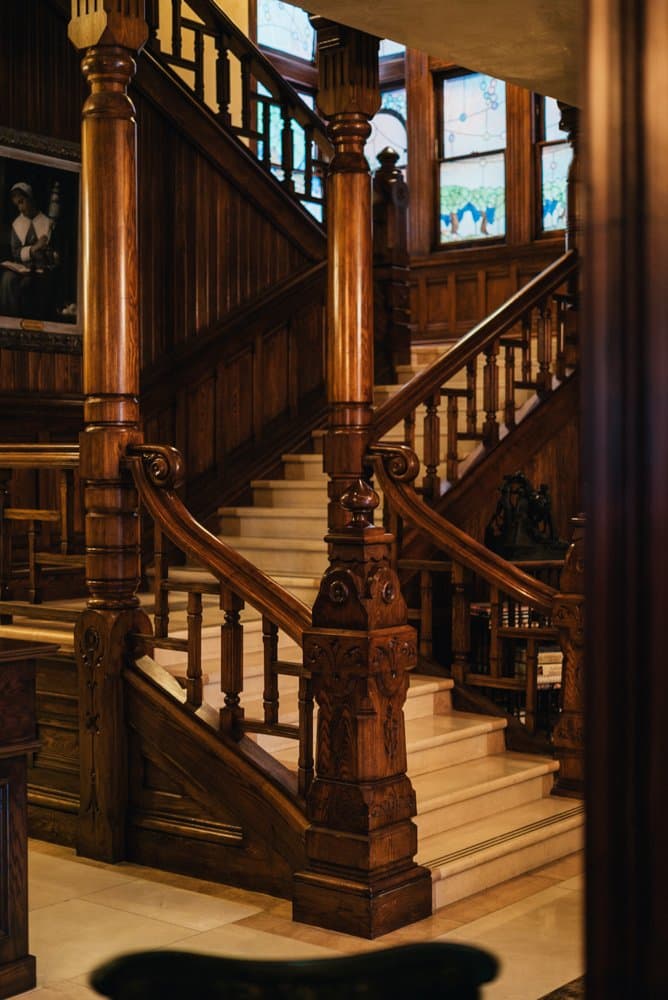
The remarkable part was invisible from the street. In 1881 most of San Francisco was still carrying water by hand and heating one room at a time. This mansion had hot and cold running water, several flushing toilets and central heating throughout, which was the sort of thing that made the trade papers; one of them recorded the final bill at $16,500. Stand inside now, under the carved millwork, with the light coming through the Tiffany glass, and the point being made is not a subtle one.
“In 1881, most of San Francisco was still carrying water by hand.”
- 1881-1882Architect William Curlett, with Theodore Eisen, raises an Eastlake/Queen Anne mansion with an octagonal turret, indoor plumbing and central heating.
- March 1882A builders' trade magazine tallies the total construction cost: $16,500.
- Chapter IIIApril 18, 1906
The Night the City Burned
For twenty-five years nothing happened to it, which is the best thing that can be said about any house. Then, at twelve minutes past five on the morning of April 18, 1906, the ground moved. The earthquake measured 7.9 and lasted less than a minute, and it was not the earthquake that destroyed San Francisco. The fires came next, and they burned for three days. When it became clear that nothing was going to stop them, the U.S. Army went down Van Ness Avenue dynamiting buildings on purpose, pulling down block after block to open a gap the fire could not cross. Some of the finest houses in the city were destroyed deliberately, by their own government, to save the rest. Almost every grand Victorian in this neighborhood went, one way or the other.
This one did not. The frame held. The turret held. The stained glass, twenty-five years old and thin as paper, held. When the smoke cleared, 1409 Sutter was one of a bare handful of pre-fire upper-class Victorians left standing anywhere in the Western Addition or Lower Pacific Heights. The Paynes did not wait to find out whether that luck would hold a second time; they left for Menlo Park. Theodore died in 1907. Mary Pauline sold the mansion around 1909, and with that the family who built it walks out of the story.
- April 18, 1906, 5:12 a.m.A magnitude-7.9 earthquake tears through San Francisco.
- The following 3 daysFire, and the Army's own dynamite along Van Ness, take nearly every mansion around it. This one comes through with its frame, turret and stained glass intact.
- Not long afterThe Payne family relocates to Menlo Park.
- 1907Theodore Payne dies.
- c. 1909Mary Pauline sells the Sutter Street mansion.
- Chapter IV1907-1980
A Hundred Years of Second Acts
Mary Pauline sold to Edgar and Ida Anderson, and after the Andersons the building simply kept finding work. By 1933 it was a meeting hall for the Japanese YMCA. From around 1940 it was the private showroom of an antiques dealer named Karl Lengfeld, who ran his business out of the ground-floor rooms for the better part of thirty years and (this matters more than it sounds) never touched the original woodwork or the glass. He closed in the late 1960s. After him came the San Francisco Medical Society, which used the place as its administrative headquarters and a health center at once. There were doctors working in the parlor.
You could call all of that a comedown for a mansion. You could also call it the reason it is still here: it was never precious, never empty, and never quite worth knocking down. The official recognition arrived on June 11, 1980, when 1409 Sutter was entered on the National Register of Historic Places under reference number 80000847, the federal government putting in writing what the building had been demonstrating, without comment, since 1906.
- Early 1900sEdgar and Ida Anderson take ownership of the mansion.
- By 1933Serves as a meeting hall for the Japanese YMCA.
- c. 1940 to late 1960sAntiques dealer Karl Lengfeld runs his private showroom out of the ground-floor rooms.
- Mid-20th centuryBecomes the administrative headquarters of the San Francisco Medical Society, doubling as a health center.
- June 11, 1980Formally added to the National Register of Historic Places, reference #80000847.
- Chapter V1990s to 2018
Ten Thousand Dollars a Night
And then the twenty-first century happened to it. The mansion had been drifting back toward hospitality for a while: by the 1990s you could rent it for a wedding. The serious attempt came in 2011, when Jing Yao and her husband bought it outright with a clear plan: a ten-room hotel for business travelers, to be called Leader House. They spent an estimated three million dollars on the renovation. They obtained the city's permission in 2013. And then, for reasons no source records, they never opened. Leader House survives today only as a name on a permit. The mansion went back on the market and stayed there for years, priced somewhere between twelve and fourteen million dollars, waiting.
What happened in the meantime is the strangest chapter in a strange history. The same owners put it on Airbnb. Under the name Payne Mansion Hotel you could book the entire mansion (all of it, every room) for $10,000 a night, plus $1,500 to clean it afterward, which for a stretch made it the most expensive listing in San Francisco. And on the same website, in the same building, on the same night, you could take a single room for seventy-four.
- 1990sThe mansion can be rented out for weddings, an early hint of the hospitality business it's in today.
- 2011Jing Yao and her husband buy the mansion, planning a ten-room hotel for business travelers: Leader House.
- 2013The city grants permission for Leader House, after an estimated $3 million in renovations. The hotel never opens.
- c. 2014-2017The mansion sits back on the market for years, asking anywhere from $12 million to $13.9 million.
- $10,000 a nightInstead, the entire mansion is listed on Airbnb as Payne Mansion Hotel: for a stretch, San Francisco's priciest listing, plus a $1,500 cleaning fee; single rooms went for as little as $74.
- Chapter VI2018 to Today
Home, Finally
In 2018 a hotelier named Bernard Rosenson bought the mansion out of its Airbnb years. He was Paris-born, already running the Mirabelle Inn up in Solvang, and he announced the hotel and a restaurant together that fall. The restaurant opened quietly that December. He called it 1881, after the year the mansion went up, and put Jean-Paul Peluffo in the kitchen and Pierre Dony in the dining room, both by way of Nice, cooking California-French for ninety covers. There has been another change of hands since, and a new look, and a new name, which brings us here.
Twelve rooms. A café on the ground floor, and a parlor library on the way. A mansion that has been a family home, a meeting hall, an antiques shop, a doctors' office, a wedding venue and the most expensive listing in San Francisco, now doing the one thing it was actually designed for, which is having people in it. The turret is still there. So are the bay windows, the carved trim, and the glass that came through the fire. Everything that made this mansion worth saving in 1906 is still the reason to come, the only real difference being that now there is a bed in it, and in the morning somebody brings you coffee.
- 2018Paris-born hotelier Bernard Rosenson, already running the Mirabelle Inn in Solvang, buys the mansion out of its Airbnb era.
- December 2018The restaurant soft-launches as 1881, named for the year the mansion was built: chef Jean-Paul Peluffo and general manager Pierre Dony, both by way of Nice, serving a California-French menu to a 90-seat dining room.
- TodayA further change in ownership and a new name bring it to Sutter Mansion: twelve rooms, the turret, bay windows and Tiffany glass all still exactly as they were.
The next chapter is already underway.
A parlor library
For quiet mornings, and the long afternoons that follow them.
And one we won't name yet
The most exclusive thing this mansion has ever offered, and the least advertised. Very few people will ever see it.
The people who already know this mansion will hear about it first.
A hundred and forty-five years in, the mansion isn't finished.
Twelve rooms inside an 1881 landmark on Sutter Street: the turret, the bay windows and the glass that came through the fire, all exactly where they have always been.